
The Parliamentary Caucus on Child Rights (PCCR) of the National Assembly, under the chairpersonship of its Convenor, Dr. Nikhat Shakeel Khan, MNA, in collaboration with the Sustainable Social Development Organization (SSDO) Pakistan, convened a high-level briefing session to review the Federal Budget 2026–27 through a Child Rights Lens and strengthen parliamentary oversight of public investments in children. SSDO Calls for Greater Investment in Children as Federal Budget 2026-27 Allocates Limited Resources to Child Rights Priorities.
The session featured a presentation based on the policy brief, “Children in the Federal Budget 2026–27: A Rapid Analysis Through a Child Rights Lens,” prepared by SSDO which provides one of the first comprehensive assessments of federal budget allocations benefiting children in Pakistan. The analysis highlighted that despite children comprising nearly half of the country’s population, Pakistan has yet to institutionalize a dedicated mechanism for tracking and reporting child-focused public expenditure.
Budget expert Amer Ejaz explained the methodology used to analyse the current budget that classify expenditures into child-specific (direct), child-related (indirect), and general public expenditure, enabling parliamentarians to better understand how public finances contribute to children’s survival, development, protection, and participation.
The briefing revealed that the Federal Budget 2026–27 allocates approximately PKR 106.5 billion in child-specific expenditure and PKR 55.8 billion in child-related expenditure, spread across education, health, nutrition, child protection, and WASH. If the BISP budget considered as social protection interventions is added, then total child related expenditure amounts to 914 billion. However, these allocations represent only a small proportion of the overall federal budget, underscoring the need for more targeted and transparent investments in children.
The presentation highlighted that significant child-specific allocations are concentrated in the education sector, including development spending under the Ministry of Federal Education and Professional Training and the Prime Minister’s Special Initiatives, particularly for the establishment of Daanish Schools in underserved areas. It also examined allocations supporting immunization, nutrition, child protection institutions, and provincial investments in health, education, water and sanitation, and disaster rehabilitation that indirectly benefit millions of children across Pakistan.
An interactive discussion followed, during which Ms. Shaista Pervaiz, MNA; Ms. Farah Naz Akbar, MNA; Ms. Kiran Imran Dar, MNA; Ms. Saba Sadiq, MNA; Ms. Zeb Jaffar, MNA; Ms. Asia Naz Tanoli, MNA; and Ms. Kiran Haider, MNA engaged with Mr. Amer Ejaz ; Syed Kausar Abbas, Executive Director; Muhammad Shahid Khan, Director Programs; and Ms. Maryam Jawad, Director Quality Assurance of SSDO on the adequacy, effectiveness, and equity of child-focused budget allocations and identified critical policy gaps requiring parliamentary attention.
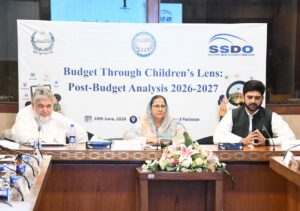
Syed Kausar Abbas, Executive Director, SSDO emphasized that child-responsive budgeting is not merely a fiscal exercise but a fundamental obligation under the Convention on the Rights of the Child and the Sustainable Development Goals (SDGs), requiring governments to maximize available resources to safeguard children’s rights. They called for the institutionalization of child-focused budget analysis within Pakistan’s public financial management system and stronger parliamentary oversight to ensure that budgetary decisions are informed by evidence and aligned with the best interests of children.
The session concluded with a renewed commitment by the Parliamentary Caucus on Child Rights and SSDO to advance evidence-based policymaking, strengthen accountability for child-related expenditures, and advocate for increased and better-targeted investments to secure a healthier, safer, and more prosperous future for every child in Pakistan.
