


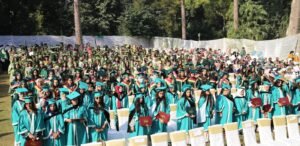
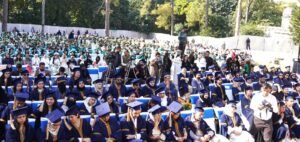
Fatima Jinnah Women University (FJWU), Pakistan’s first public-sector university dedicated to women’s higher education, held its 23rd Convocation on Wednesday, with Federal Minister for Planning, Development and Special Initiatives Mr. Ahsan Iqbal Chaudhry attending as Chief Guest. A total of 1,439 students received degrees, including 1,230 bachelor’s, 179 MS/MPhil and 30 PhD graduates. The University also awarded 41 gold and 27 silver medals to outstanding students.
The ceremony was attended by Prof. Dr. Arshad Bhatti, Vice Chancellor, Virtual University of Pakistan; Registrar Bahria University and Dr. Rafia Mumtaz, Vice Chancellor, Kohsar University Murree, along with senior university officials, faculty members, graduates and their families.
Addressing the graduates, Mr. Ahsan Iqbal recalled the establishment of FJWU in 1998, when the historic Old Presidency building was converted into Pakistan’s first public-sector women’s university on the directions of then Prime Minister Mian Muhammad Nawaz Sharif. He emphasised that education was essential for overcoming poverty and achieving national progress. Referring to the graduates as “Generation 2047”, he expressed confidence that young people would lead Pakistan towards greater development as the country approaches its centenary of independence. He urged them to follow the example of Mohtarma Fatima Jinnah, rise above hatred, embrace emerging technologies, particularly artificial intelligence, and contribute positively to society. He also acknowledged the role of parents and teachers in shaping the graduates’ academic and personal achievements.
In her address, Vice Chancellor Prof. Dr. Bushra Mirza (PoP, T.I.) congratulated the graduates and urged them to use their education with integrity, courage and compassion, embrace technology thoughtfully and remain committed to supporting future generations. She also encouraged them to maintain their connection with the University as alumnae and contribute to society through their professional achievements.
The Vice Chancellor highlighted FJWU’s academic expansion, noting that the University now offers 104 degree programmes across 32 departments. New academic initiatives include Human Nutrition and Dietetics, FinTech, Data Science, and Robotics and Artificial Intelligence. Admissions and recruitment processes have been digitised through the University Management System, while a smart classroom has been established at Campus II and Open and Distance Learning introduced in collaboration with Virtual University.
Highlighting the University’s international standing, she said FJWU secured 641st position among 1,722 institutions in the QS Asia University Rankings 2027 and 178th in Southern Asia. It was placed in the 401-600 band in the Times Higher Education Impact Rankings 2025 and secured first position among women’s universities worldwide in the World University Rankings for Innovation (WURI) 2026, including first place globally in the Industrial Application category. FJWU also emerged as Pakistan’s top-ranked women’s university in the QS Sustainability Rankings 2027.
On the research front, the University secured 21 research projects with reported funding of approximately Rs. 1.589 billion through national and international collaborations. Three FJWU faculty members were recognised in the 2026 Stanford University-Elsevier list of the world’s top two per cent of scientists. The University also continues to strengthen international research engagement through collaborations with Erasmus Mundus, DAAD and the Alexander von Humboldt Foundation.
FJWU students also recorded notable achievements in national and international competitions. The University’s team secured fourth position among 33 teams at the Jessup International Moot Court Competition 2026, while Ms. Nimra Rafique, Captain of the Pakistan Women’s Blind Cricket Team, received the Prime Minister Award 2026. Other achievements included a silver medal at the Pak-China Games, second position at EMCOT 2026 for an innovative smart wristband, and first position in the Climate Change category at SEE Pakistan 2026 for the student startup Cardana Utensils. Two Media Studies students also secured grants of Rs. 1 million each under the Chief Minister Punjab Film Fund.
The University further expanded its national and international engagement through 21 research projects and academic collaborations, participation in the Pak-UK Gateway project and an academic delegation to Germany. It also hosts the secretariat of the All-Pakistan Women Universities Consortium and has strengthened outreach through a World Bank-funded education project involving 57 students from Balochistan.
In infrastructure development, FJWU completed the installation of a 756.38 kWp solar energy system across both campuses at a cost of Rs. 100 million and inaugurated a new hostel with a capacity of 300 students. The University is also pursuing conservation of its historic Bachan Niwas building in collaboration with the Directorate General of Archaeology and the Aga Khan Foundation. Future development plans include an Autism and Well-Being Centre, an Advanced Artificial Intelligence Laboratory, a Nursing and Midwifery College and a Diagnostic Laboratory. The Vice Chancellor also sought the Federal Minister’s support for pending development projects, including an auditorium, Campus II boundary wall and transport facility.
The ceremony concluded with the presentation of souvenirs to distinguished guests and a group photograph.
Established in 1998, Fatima Jinnah Women University continues to advance women’s higher education, research and innovation in Pakistan, serving approximately 8,397 students through 32 departments and 104 academic programmes.
